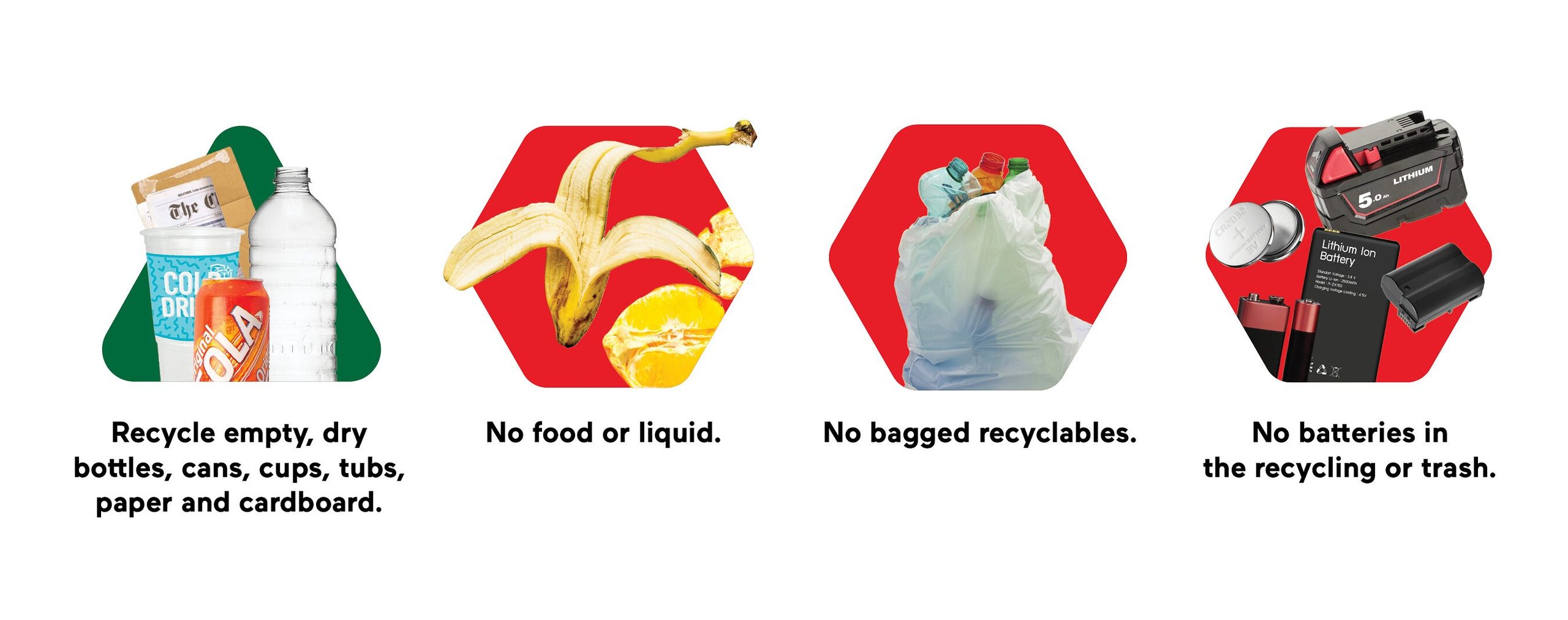

June Spotlight from Waste Management : Sustainable Landscaping—Keep it Organic

Summer is prime time for mowing, weeding, and garden cleanups. While these natural materials are perfect for creating nutrient-rich compost, unexpected items often find their way into yard waste containers, creating challenges at our processing facilities.

Three Tips for Clean Summer Yard Waste:

  • Keep Plastics Out: Please remember that plastic flowerpots, seed trays, and water bottles should never be mixed with leaves, grass, or branches. These non-compostable materials degrade the quality of the final compost.
  • Ditch the “Tanglers”: Upgrading your outdoor setup can leave you with old garden hoses or ropes. These items are severe hazards that easily wind around processing machinery, causing facility delays.
  • Loose and Natural: Ensure only pure organic debris goes into your designated yard waste bags or carts. Keeping these streams separate allows us to effectively process the material back into useful natural resources.

The Core Goal

Proper sorting at the curb ensures that your neighborhood’s organic material is successfully repurposed into high-quality compost rather than ending up in a landfill.

For more local disposal guidelines, visit wm.com/RecycleRight.

Village of Maple Park Condemns Illinois BUILD Act as Another Springfield Mandate on Small-Town America

FOR IMMEDIATE RELEASE

Statement from Village President Chris Rebone with the Support of the Maple Park Board of Trustees

MAPLE PARK, ILLINOIS — The Village of Maple Park, with the unanimous support of the Village Board of Trustees, stands in absolute opposition to the Illinois BUILD Act and the continued effort by Springfield politicians to dictate how small communities must govern themselves.

The residents of Maple Park did not elect state bureaucrats to run their village. The elected local officials who live here, pay taxes here, raise families here, and answer directly to the people who call this community home. Yet the Illinois BUILD Act represents another attempt by Springfield to impose a one-size-fits-all mandate on the communities that bear little resemblance to the urban centers where these policies are conceived.

Maple Park is a village of approximately 1,500 residents. We are not Chicago. We are not a sprawling metropolitan government with unlimited staff, consultants, and resources. We operate responsibly, carefully manage taxpayer dollars, and make decisions based on the needs of our residents — not the political priorities of legislators hundreds of miles away.

The Illinois BUILD Act continues a troubling pattern of state government believing it knows better than local communities. Every new mandate carries a cost. Every new requirement consumes staff time, taxpayer resources, and local flexibility. Springfield politicians are quick to pass mandates but remarkably reluctant to pay for them. The result is predictable: higher costs, greater bureaucracy, and less local control.

For years, state leaders have spoken about empowering local governments while simultaneously stripping local governments of the ability to make decisions for themselves. The Illinois BUILD Act is not about partnership. It is about control. It is another example of Springfield substituting its judgment for that of locally elected officials who understand their communities far better than distant lawmakers ever could.

The citizens of Maple Park deserve the right to shape the future of their own community. Decisions affecting our residents, businesses, infrastructure, and local priorities should be made in Maple Park — not dictated from Springfield through blanket mandates that ignore the realities facing small towns.

The Village Board and I believe strongly that government works best when decisions are made closest to the people they affect. The Illinois BUILD Act moves Illinois in the opposite direction. It expands state interference, undermines local authority, and places additional burdens on communities that are already working hard to deliver services efficiently and responsibly.

We call upon legislators representing rural and suburban Illinois to stand with the communities they serve and reject the notion that Springfield should have greater authority over local government than the people who actually live in those communities.

Maple Park will continue to advocate for local control, fiscal responsibility, and the right of our residents to govern their own future. We urge lawmakers to abandon this misguided legislation and instead work collaboratively with municipalities rather than imposing yet another top-down mandate.

Springfield should trust local communities. If a village of 1,500 people cannot be trusted to make decisions for itself, then the problem is not local government — it is the growing belief in Springfield that every community must be governed from the state capitol.

Chris Rebone
Village President
Village of Maple Park

Supported by the Maple Park Board of Trustees